Clear beer + the liquid fraction of the foam head
Pour geometryInteractive study
Pint Geometry Lab
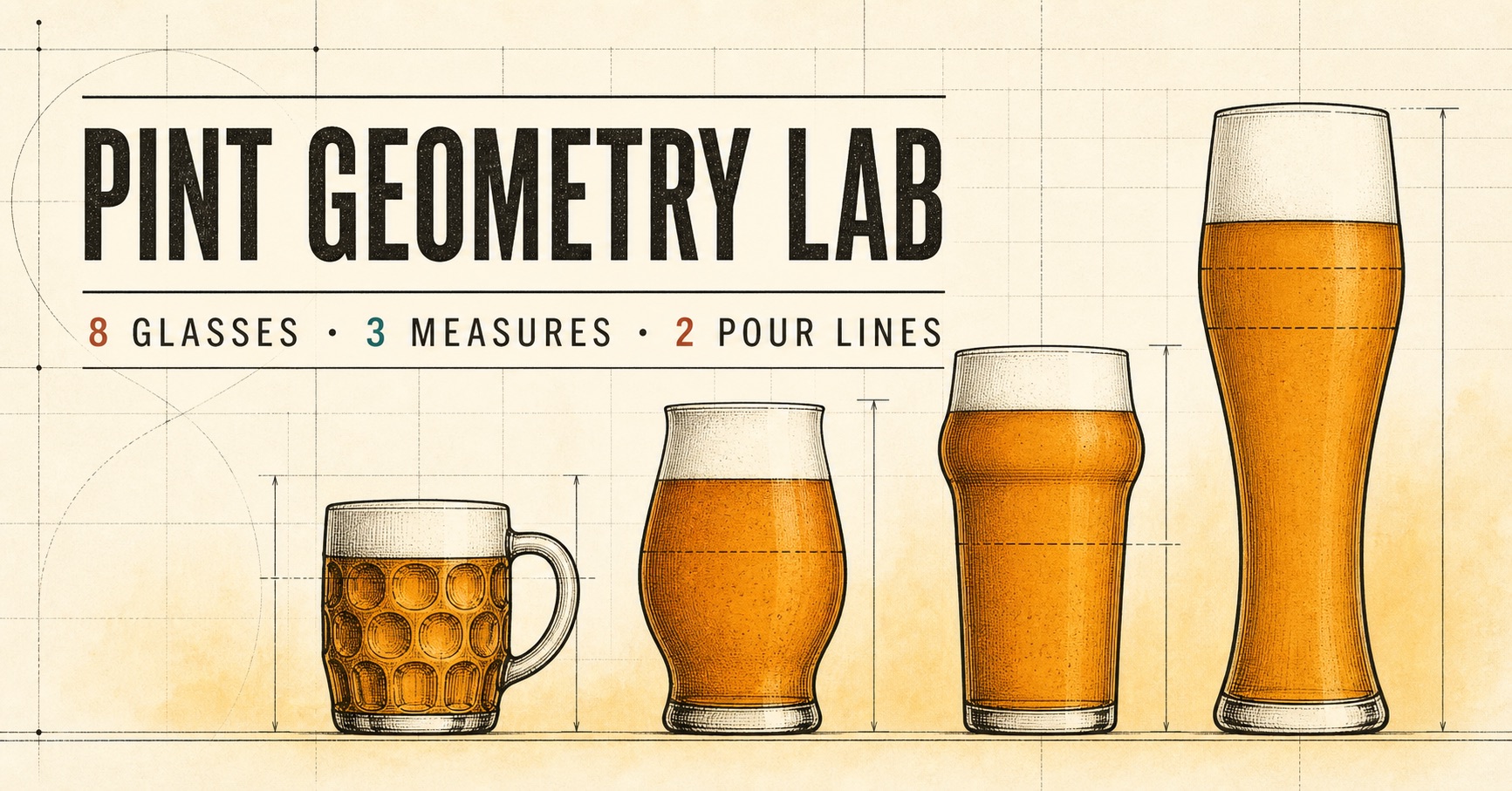
Eight glasses · three measures · two pour lines
See why “halfway up” is rarely half a pint. Explore how eight familiar beer-glass profiles turn physical fill depth into liquid, foam and settled volume.
01
Choose the glass
02
Set the pour
Target liquid line — clear-beer surface for 568 ml after settling, with foam reaching the rim. Inner percentages use the whole usable glass height.Typical liquid-line band — where the beer surface sits for this glass’s modeled head range, with foam reaching the rim.
Arcoroc 20 oz Nonik ↗Current scaled model: 152 mm high × 87 mm maximum diameter. Liquid depth: 146 mm.
Wet foam holds more beer; published 1-minute density: 14–24%.
Glass guide targets this profile’s 5.0% head reference within its 0.0–5.0% range. Brim capacity is 593 ml — 24 ml above the selected settled measure. More reserve lowers the Target liquid line and makes room for a deeper head; at 0%, a Target pour has no foam head.
Target mode fills foam to the rim and sets the clear-beer surface so the liquid total after settling equals the selected measure. Drag either handle for a custom pour; head depth is measured upward from the liquid line, not from the base.
Unfilled volume above the foam-top line
5% of brim capacity
Estimated liquid released as the head settles
95% of brim capacity
03
Compare real depth
Compare the same physical depth, the same share of usable vessel height, or the same position relative to the model’s Target liquid line.
Physical liquid depth (mm)
The marker applies the selected glass’s physical liquid depth to every profile.
| Profile | Scaled H × Ø | Liquid at comparison point | Target liquid depth |
|---|---|---|---|
| Conical | 152 × 85 mm | 561 ml | 147 mm |
| Pub tulip | 161 × 84 mm | 521 ml | 155 mm |
| Nonik | 152 × 87 mm | 563 ml | 146 mm |
| Dimple | 124 × 100 mm | Above rim | 118 mm |
| Willibecher | 185 × 84 mm | 430 ml | 178 mm |
| Pilsner flute | 242 × 71 mm | 247 ml | 236 mm |
| Pilstulpe | 231 × 93 mm | 535 ml | 153 mm |
| Weizen | 248 × 85 mm | 212 ml | 240 mm |
“Usable vessel height” runs from the interior base to the rim. “Target” is the clear-beer line that produces the selected settled measure when foam reaches the rim, including the current reserve and foam-liquid assumptions. For the stemmed Pilstulpe, overall height includes the foot and stem, while chart height measures the bowl only.
04
How to read the model
Reference moulds, scaled by volume
Each profile starts with a published reference height and diameter. Changing the selected measure scales all three dimensions together; changing reserve changes capacity assumptions, not the glass’s physical screen size.
Horizontal slices, added up
The vessel is treated as a stack of tiny circular slices. The tool integrates πr² through the liquid depth and separately through the foam and empty regions.
A comparative instrument
Real moulds, wall thickness, dimples and foam drainage vary. These named reference profiles are more faithful than generic silhouettes, but they are not manufacturing drawings or a legal dispense test.